








CUISINE
The Book with 75 Recipes, 19 Species, 21 Fisherman, 6 Ports & One Island
By Shelley Admundson, Photography by Randi Baird
Harvesting and growing food from the sea is no easy task. You need to be something of a human Swiss Army knife, equipped with a suite of skills to be flipped into action at a moment’s notice: a plumber at the ready to repair unexpected leaks; a doctor, stitching up fingers, taping up wounds and making the call when to turn into shore or radio for help; a scientist, tracking water temperatures, examining fish gut contents, cataloging seafloor typography, and noticing species’ behavioral shifts; an electrician, splicing wires to ensure accurate locations, running lights, and sometimes tunes. Your day starts early, usually hours before the sun is up, with the starting time dependent on the speed of your boat, the distance to your fishing grounds or gear, and your goals for the day. You must adapt to the weather and tides, fishing regulations and seasons, and the market demand for your catch. The day can be repetitive–hauling gear, sorting, measuring, rebaiting, resetting–a rhythm that becomes a meditation to some, a joint-grinder to others, but ultimately a hopeful ritual that brings up a catch to be sold. By the time you are heading in you have already had more than a full day’s work, and are eager to unload and head home to shower, eat, and sleep so you can get back at it again.
Independent, artisanal fishermen (or fishers) work hard to make a living. We, at the Martha’s Vineyard Fishermen’s Preservation Trust (MVFPT), a non-profit organization committed to supporting the Island’s commercial fishermen and their sustainably harvested catch, work hard to provide the land-based support that is needed for these sea-based businesses. We facilitate access to expensive fishing permits and quota through individualized loan programs; we maintain waterfront fishing infrastructure; we conduct fisheries research and participate in the refinement of sustainable fishery regulations; we donate seafood to islanders experiencing food insecurity; we market and sell local catch through our MV Seafood Collaborative wholesale market; and we educate the community on the breadth of local, sustainable seafood choices.
Each book purchase supports our mission and bolsters our efforts to ensure that this important sea-based culture, livelihood, skillset, and food source remains vibrant on the Island for generations to come.
This book includes the profiles and portraits of twenty-one Island fishermen from an assortment of fisheries. Each profile shares a glimpse into a livelihood unique to those who work on the water. Their portraits, captured by photographer Brooke Bartletta, help us connect, appreciate, and thank the people who feed our community from the sea.
This book is a guide, profiling the local species that are readily available, teaching us how and when they are harvested, and most importantly, how to cook them. It is a collection of tried and true delicious seafood recipes thanks to the generosity of a community of chefs, restaurants, caterers, food writers, librarians, private chefs, summer residents, year-round residents, friends, family, fishermen, and the expertise of Catherine Walthers. The recipes have been brought to life by skilled photographer, Randi Baird, to inspire you to bring the same beauty to your table.
We hope this book will encourage you to seek out the many varieties of local fish, shellfish, and crustaceans thoughtfully harvested or grown by our fishing community (or whatever fishing community you live near). We hope it will teach you how to prepare the seafood you’ve selected, and maybe even inspire you to create your own recipes. When you choose local seafood you directly support small businesses working hard to survive within a competitive, global seafood marketplace. By eating locally, you consume fresher, more nutrient-dense food, and also reduce your carbon footprint by eliminating the need for long-distance transport. Our local seafood is harvested with pride and care, by people whose faces you may now recognize and whose stories you may now remember. Each meal is more than just sustenance–it’s a connection to the people who pulled it from the sea and a commitment to keeping our waters, our fishermen, and our coastal heritage thriving.
Martha’s Vineyard Fishermen’s Preservation Trust
SAFEGUARDING THE ISLAND’S COMMERCIAL FISHING HERITAGE & FUTURE
The Martha’s Vineyard Fishermen’s Preservation Trust (MVFPT), is a non-profit founded in 2011 to safeguard the island’s commercial fishing heritage and future by (1) Preserving the historic small boat fishing fleet, its community and way of life, on Martha’s Vineyard; (2) Protecting the marine populations and fishing grounds off the coast of Martha’s Vineyard and New England; and (3) Educating the community about its local fisheries.
We assist each part of the system necessary to land fresh, sustainable seafood on our Island–from establishing creative payment plans that help fishermen secure expensive fishing permits, to engaging in collaborative scientific research projects which help us better understand fishing stocks, to donating seafood to our local food equity groups–each piece of our work is necessary to keep our seafood access, our heritage, and our waterfront economy strong.
As part of our mission, we operate a seafood market, the Martha’s Vineyard Seafood Collaborative, on the docks of Menemsha. You may have seen our building and sign on the waterfront and wondered what happens here–or how it connects to the MVFPT. Our facility provides the critical infrastructure needed to support the island’s fishing fleet: We have a 5-ton ice machine, a gin-boom or hydraulic crane used to offload heavy catch, multiple walk-in coolers to safely store fresh catch, a flash freezer to preserve seafood at its freshest point, and more. While we do not sell directly to customers from our building, we do sell local seafood–fresh and frozen–at the West Tisbury Farmers Market and through our Community Supported Fishery (CSF) program. Connecting the sea to your table is a core part of our mission. We hope this book, The Sea Table, gives you the tools to confidently buy, cook, and celebrate the bounty of our local waters and the fishermen that bring it to shore.
Please consider purchasing this book available on their website: mvfishermenspreservationtrust.org also available at Alley’s General Store, Beetlebung Farm, Bunch of Grapes, Copperworks, Edgartown Books, Larsen's Fish Market, LeRoux, Menemsha Fish Market, Menemsha Texaco, North Tisbury Farm, Pandora's Box, The Seven Sisters, and West Chop Club.
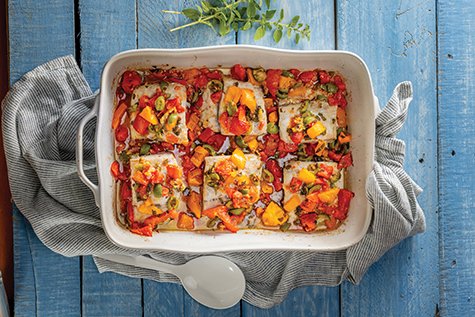
Italian Baked Bluefish with Tomatoes, Garlic & Olives
Serves 6
Recipe by Catherine Walthers
Ingredients:
6 (6 to 8-ounce) portions of bluefish
2 tbsps. extra-virgin olive oil, plus 1 tbsp. for oiling the baking dish Salt and freshly ground pepper
2 cups chopped fresh tomatoes, yellow and red if available (about 4 tomatoes), about ½-inch diced
½ cup pitted green olives, such as Castelvetrano, roughly chopped
2 tsps. finely minced garlic
3 tbsps. fresh oregano leaves, chopped (or 2 tsps. dried oregano)
Lemon wedges for serving
Instructions: Preheat the oven to 400°F. Oil a glass baking dish with 1 tablespoon of olive oil, or line with parchment paper. Season the fish with salt and pepper.
In a bowl, mix together the remaining 2 tablespoons of olive oil, to¬tomatoes, olives, garlic, and oregano. Season the tomato mixture with salt, and pour over and around the fish. You can make the tomato mixture up to an hour before baking and leave on the counter, but it’s best to cut the tomatoes as close to cooking as possible, so they don’t lose too much liquid.
Bake for 18 to 25 minutes, depending on the size of the fish, until flaky or easily pierced with a fork. If using an instant-read thermometer, remove the fish at 140°F. Lift the fish with a spatula, so you leave the skin in the baking dish. Serve with a lemon wedge for additional acidity, if needed.