










ARTIST PROFILE
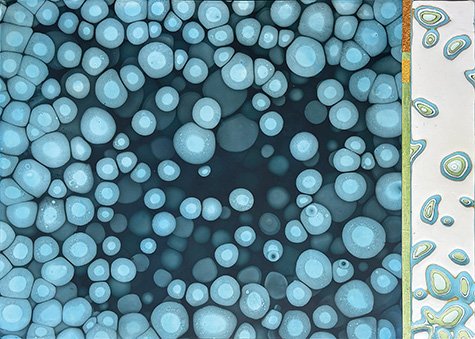
The Intriguing and Alluring Art Of Susie White
By Abby Remer
Susie White’s stunning art beckons us to come in for a closer look. She fits separate panels together like a sophisticated jigsaw puzzle to create dynamic, often quite large works. The designs on the individual components are inspired by nature. White explains, “They start from a seed of organic inspiration: the way lichen grows on a stone wall, the intense color of marsh grass in early summer, or patterns found in ice.” The panels seem to offer a microscopic view, so that swirls, streaks, meandering lines, and floating cell-like forms become pure abstractions of color and form. White delights in combining panels with very different patterns, colors, and textures to create intriguing final “constructions” that convey a single, connected idea.
White’s enigmatic titles invite us, as viewers, to interpret them in our own way. For instance, in “Early Spring,” elongated amoeba-like forms on the left seem to glide across the crowded surface, as if swimming in the multicolored ocean panel to the right, with white sand or sea foam possibly in the small rectangle below. It is equally possible that you see something entirely different, making each work a personal journey.
Likewise, consider the work “I Can Barely See, But I Hear the Sound”. Are the images an interpretation of sound that is heard or a physical sound of water that is barely seen?
Nature is present everywhere, despite the abstract style of White’s compositions. The two sides in “Murmuration” are visually distinct, yet united by warm, reddish-brown colors. The work’s title adds another layer of meaning when we realize that “murmuration” refers to a large gathering of starlings creating intricate patterns in flight, possibly imparting a specific interpretation to the swirly mosaic in the left-hand panel.
“I like shifting between scales and changing perspectives, from the micro to the macro, as though one is a magnification of the other,” White shares.
“Things look so very different when you’re in them versus stepping away.” This duality seems to appear in “Summer Float,” with the left side panel offering a bird’s-eye view of a large landmass surrounded by water, while the right side is perhaps a microscopic detail.
“It’s all about connection to place and nature,” says White. “Although I don’t paint recognizable Vineyard scenes, the work is very much about my experience on the island. I like to distill everything down to the essence of its shapes or feelings. I try to make it universal so that anyone can connect with it. I hope to give enough visual information that you can put into it what you want.”
Growing up in Chicago, art was always a part of White’s life. “Drawing and painting were my thing.” Although she earned a B.A. in Fine Arts from Ithaca College, White shares, “I never thought I would be making art as a career. I just assumed I’d go into advertising, like my dad, and have a job.”
The universe had other plans; however, White’s journey was a bit circuitous. “I did everything but pursue my art. I worked for my dad for a summer and said, ‘No way, Jose, am I going to do advertising.’ I worked in the arts, painting backdrops for theater in Boston.” But after White’s husband worked running boats on a local film produc-tion, the couple moved to L.A. to pursue their work full-time on the West Coast.
Once there, White worked in the entertainment industry as a set painter and scenic artist, applying faux finishes to set pieces for music videos, commercials, television, and film. These experiences shaped the techniques she would later incorporate into her fine art. White’s work involved painting surfaces to resemble other materials, such as wood or concrete. She enjoyed using many nontraditional art materials and methods to achieve effects such as transforming a pristine set into an old, rundown hotel by applying shellac to make it crackle, or beating objects with chains to give them an aged appearance. “I did a job where I painted over graffiti on a tree to make it look like a proper tree again.”
However, the materials she used on sets were often toxic, and the work was demanding. “We might have to spray lacquer on the set for 10 hours,” White recalls. She shifted to film and televi-sion production, leaving more time to devote to her own art. Soon, several set designers became interested in her fine art and began incorporating it into their productions.
The next step that shaped her current process came when White began experimenting with small pieces of wood lying around a friend’s loft space. “Their size let me try something out and then move on. After about a month, I laid them all out. I loved how I could take a piece that was cool on its own, but when I placed it next to another, the combination was more interesting as they played off each other. That’s how I started combining them.”
Today, White finds inspiration in nature during her walks on the Vineyard, where she has lived since 2016. She was introduced to the Island through her husband, and the couple spent many summers visiting an old family camp on Tashmoo before moving here full-time. White considers those early days, when she overlooked layers of lake, sand, and sound, a lasting influence on her art. Nowadays, White shares, “I might be inspired, say, by lady slippers or a section of moss that blew my mind on a walk. I can come back and paint about that and then set it aside. When I am inundated with panels, I start composing them, playing around. I’m a huge puzzle fan, but you have to have enough to choose from so you’re not forcing them together.” Ultimately, though, she says, “Metaphorically, it’s very much like life with each piece recalling a moment in time that comes together to tell a story.”
White’s varied surfaces captivate our gaze through their physicality, defined by depth and surface textures. Her process varies, but she typically builds the pieces in layers. White starts with Masonite tempered on both sides, providing a sturdy base on which to build up her surfaces. She selects her colors from numerous thin-nozzle squeeze bottles of acrylic paint that line her studio wall. White pours and manipulates the pigments in various ways, sometimes using different techniques or tools, such as layering materials and letting them react chemically to produce a unique effect.
Next, White might add a layer of clear epoxy, more paint, another layer of epoxy, and finally a matte spray to avoid reflective glare. Sometimes, during the process, she will sand one of the surfaces, revealing what was beneath, or carve the surface as another way to create texture. “I just love experimenting with the materials.”
White’s finished pieces are conversations among their parts. We can see this in “Summer Float” , “Sea Foam”, “Ice Bound”, and many more. She often works with a predominantly blue palette, yet the range of shades is as vast as the individual patterns and final compositions she creates. Having painted this way for some 25 years, White shows no signs of running out of ideas, continually creat-ing intriguing and alluring constructions that leave us thirsting for more.
Susie White’s work is continuously on view at the Field Gallery in West Tisbury. An exhibition of new work runs from June 27 through July 8th. For more information, visit: susiewhiteartist.com and on Instagram: @paintsusie.